Wardrobes in Cyprus: sliding or hinged, and how big you really need
Wardrobes in Cyprus: sliding or hinged doors, how much space you need in front, the right depth for hangers, damp-proofing tips and how to measure height.
 Angela HadjiconstantinouFounder & Interior Designer5 Nov 2026 · 16 min read
In this article
- 1Sliding or hinged wardrobe: which is better?
- 2How much space do you need in front of a wardrobe?
- 3How deep should a wardrobe be for hangers?
- 4Hanging, shelves or drawers: what mix do you need?
- 5Are mirrored wardrobe doors a good idea?
- 6How do you stop a wardrobe getting damp in Cyprus?
- 7How do you measure for a wardrobe, including height and skirting?
- 8Should you pay for wardrobe assembly?
- 9Mistakes I see all the time
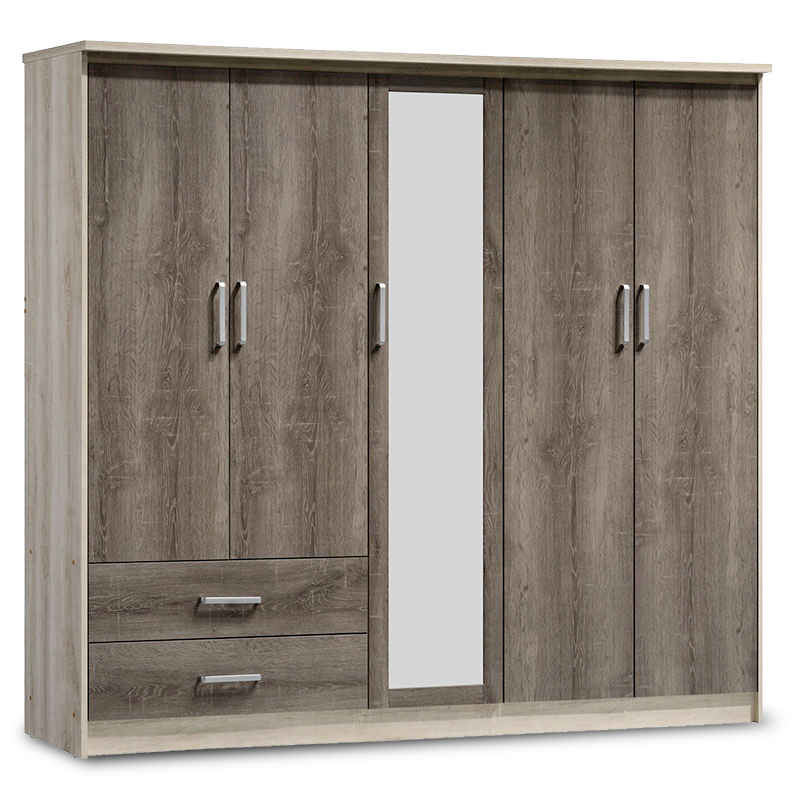
Choosing wardrobes in Cyprus comes down to three measurements most people skip: the clear space in front of the wardrobe, the internal depth and the ceiling height. Hinged doors need room to swing open. Sliding doors need none, but you only ever see half the wardrobe at a time. Get those three right, then plan the inside around the clothes you actually own.
Short answer: choose sliding doors if the bed or a wall is close, hinged doors if you have space and want to see everything at once, and look for around 55–60 cm of depth if you want to hang clothes on a rail.
A wardrobe is the biggest piece in most bedrooms and the one people regret fastest when it is wrong. Browse our wardrobes with a tape measure in your other hand, but read this first.
Sliding or hinged wardrobe: which is better?
Neither is better in general. Sliding doors suit tight rooms. Hinged doors suit rooms where you can stand back and open everything.
| Feature | Sliding doors | Hinged doors |
|---|---|---|
| Space in front | Only room to stand | Door width plus room to stand |
| Access | About half the interior at a time | Everything at once |
| Mirrors | Often a full door panel | Usually on one or two doors |
| Best for | Small bedrooms, beds close to the wardrobe | Larger rooms, people who like to see all their clothes |
| Watch out for | Internal drawers blocked by the overlapping doors | Doors hitting the bed, a bedside table or the AC unit |
For a compact bedroom with a double bed, I would lean towards sliding wardrobes. In a larger room, or a guest room that is rarely full, hinged wardrobes give you better access for the same width.
How much space do you need in front of a wardrobe?
For hinged doors, allow at least the width of one door plus room to stand, which in practice means about 90 cm of clear floor. For sliding doors, 60–70 cm is workable, because you only need space for yourself.
Measure from the front of the wardrobe to the nearest obstacle: the bed, a desk, a bedside table or the bedroom door. Then picture opening a drawer inside the wardrobe while someone walks past. If it feels cramped on paper, it will feel worse in real life. Planning the whole room? Size the double bed and the wardrobe together, not one at a time.
How deep should a wardrobe be for hangers?
For clothes hanging sideways on a rail, look for an internal depth of about 55 cm, which usually means 58–60 cm on the outside. An adult hanger is roughly 45 cm wide, and clothes need a little air around them.
Shallower wardrobes, around 35–45 cm, are not useless. They suit shelves, a front-facing rail or a hallway, just not a full hanging wardrobe. Every product page lists the dimensions, so check the depth before you fall for the doors.
Hanging, shelves or drawers: what mix do you need?
Start with your clothes, not the catalogue. Count what you hang, what you fold and what you throw in a drawer, then choose the interior to match.
- Long hanging for dresses, coats and long trousers: roughly 140–160 cm of drop.
- Short hanging for shirts and jackets: about 90–100 cm, with two rails stacked if the height allows.
- Shelves for jumpers, jeans and bedding. About 30–35 cm between shelves stops piles toppling over.
- Drawers for underwear, socks, gym kit and anything small.
- A top section for suitcases and out-of-season clothes. In Cyprus, that is where the winter duvet lives for most of the year.
- Room to grow. A wardrobe that is full on day one is already too small.


Are mirrored wardrobe doors a good idea?
Yes, in small bedrooms. A mirrored door gives you a full-length mirror without using any wall, and it makes a narrow room feel wider.
The downsides are honest ones: fingerprints, and a view of the bed you may or may not want first thing in the morning. Think about the light too. A mirror opposite a window bounces a lot of Cyprus sunshine around the room, which is lovely in January and less so on an August afternoon. If you would rather keep the doors plain, a dressing table with its own mirror is a good alternative.
How do you stop a wardrobe getting damp in Cyprus?
Give it air. Damp and musty smells usually come from a wardrobe pushed hard against a cold external wall, packed tight, in a room that is rarely aired.
- Leave a gap of a few centimetres between the back of the wardrobe and an external wall.
- Never put clothes away damp, especially in winter when things dry slowly indoors.
- Open the windows every day, even briefly, and use a dehumidifier in damp months if your home needs one.
- Put moisture absorbers inside and check them regularly.
- Do not overfill. Air needs to move between the clothes.
- Let new paint or plaster dry fully before the wardrobe goes against it.
Homes near the sea and ground-floor flats tend to need more of this. In summer the air conditioning dries the air for you. Winter is when you need to pay attention.
How do you measure for a wardrobe, including height and skirting?
Measure width, height and depth at more than one point, and remember that the wardrobe has to stand up inside the room.
Tall wardrobes are usually assembled lying down and then tilted upright. The diagonal of the side panel has to be shorter than the ceiling height, or it will not stand up, so leave a few centimetres to spare. Then check the skirting board. It pushes the wardrobe forward by its own thickness, and the top can end up leaning away from the wall unless you allow for it. Look out for sockets, light switches, window sills, AC units and the swing of the bedroom door. Our guide on how to measure before ordering furniture walks you through it, and the size guide shows standard sizes.
Should you pay for wardrobe assembly?
For a large wardrobe, I would. Wardrobes are tall, heavy and fiddly, and sliding doors need careful adjustment to run smoothly.
Assembly is available on eligible items. You add it at checkout and the cost is shown before you pay. Whoever assembles it, a tall wardrobe should be fixed to the wall so it cannot tip. Delivery normally takes 15–20 days, longer for made-to-order items, and the details are on our delivery page.


Mistakes I see all the time
- Measuring the wall and forgetting the room. The wardrobe fits. The doors do not open.
- Hinged doors right next to the bed. Every morning becomes a small negotiation.
- Buying shallow and expecting to hang a coat. Check the depth. Then check it again.
- Ignoring the skirting board. A wardrobe leaning forward is not a design feature.
- All hanging and no drawers. Or the other way round. Count your clothes first.
- Pushing it tight against an external wall. Then wondering why the shirts smell of damp in February.
Browse our bedroom furniture, and if you are furnishing a whole home, our furniture packages are worth a look. Send me the wall width, the ceiling height and the distance to the bed on WhatsApp at +357 96 592277, and we will tell you which wardrobe fits and which door type makes sense.
Add Argos The Classics as a preferred source on Google →
Frequently asked questions
Are sliding or hinged wardrobes better for a small bedroom?
Sliding wardrobes are usually better for a small bedroom because the doors need no space to swing open. The trade-off is that you only see about half the interior at a time.
How much space do you need in front of a hinged wardrobe?
Allow at least the width of one door plus room to stand, which usually means about 90 cm of clear floor in front of the wardrobe. Sliding doors can work with around 60–70 cm.
What is the standard depth of a wardrobe for hanging clothes?
For clothes hanging sideways on a rail, look for an internal depth of about 55 cm, which is usually 58–60 cm on the outside. Shallower wardrobes suit shelves or front-facing rails.
How do I stop my wardrobe getting damp in Cyprus?
Leave a gap of a few centimetres from external walls, never put clothes away damp, air the room daily and use moisture absorbers or a dehumidifier in the damp months. Avoid overfilling so air can move.
How tall should the ceiling be for a tall wardrobe?
Tall wardrobes are often assembled lying down and tilted upright, so the diagonal of the side panel must be shorter than the ceiling height. Leave a few centimetres to spare and allow for the skirting board.
Does Argos The Classics assemble wardrobes?
Assembly is available on eligible items. If a wardrobe is eligible, you add assembly at checkout and see the cost before you pay.