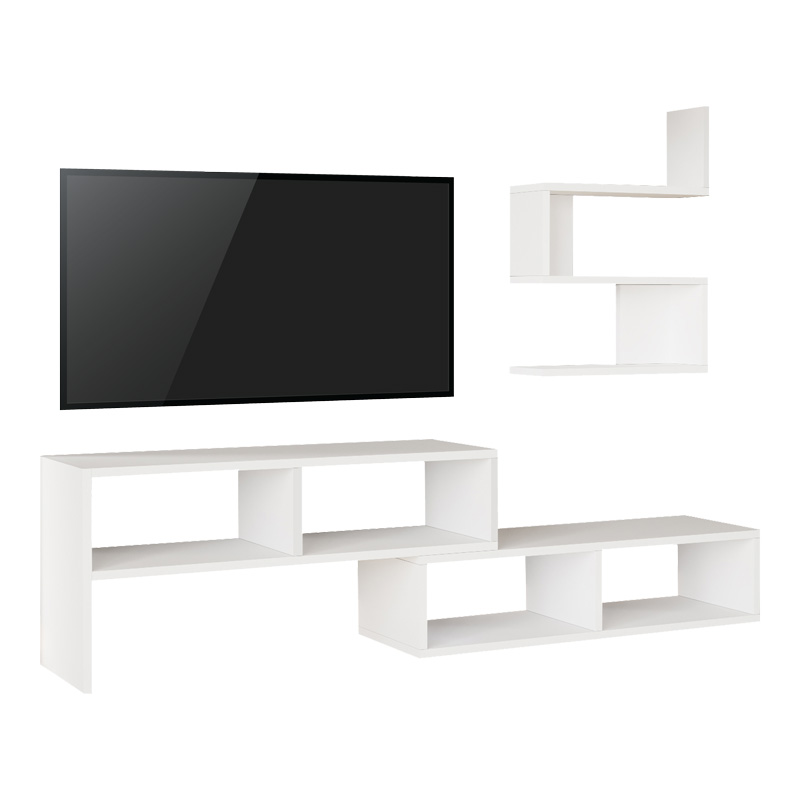
TV stands in Cyprus: how to choose the right size and style
TV stands in Cyprus: how wide and how high to go for your screen, wall unit or low stand, hiding cables and matching the coffee table. A designer's guide.
 Angela HadjiconstantinouFounder & Interior Designer2 Nov 2026 · 16 min read
In this article
- 1How wide should a TV stand be for my TV?
- 2How high should a TV stand be?
- 3Wall unit or low TV stand: which should I choose?
- 4How do I hide the cables behind a TV stand?
- 5How much storage do I need in a TV stand?
- 6Which material is best for a TV stand?
- 7Should the TV stand match the coffee table?
- 8What TV stand works in a small living room?
- 9Mistakes I see all the time
The right TV stand is wider than your TV, low enough that the middle of the screen sits close to eye level when you are seated, and deep enough to hold the TV’s feet with room to spare. Get those three right and the rest – storage, cables, style – is the enjoyable part. When people ask me about TV stands in Cyprus, that is where I start, and you can compare sizes and finishes in our TV stands category, where every product page lists dimensions and materials.
Short answer: Pick a TV stand that is clearly wider than the screen, roughly 40 to 60 cm high for sofa viewing, with closed storage and a cable outlet at the back. Measure the TV, the wall and the walkway before you think about style.
How wide should a TV stand be for my TV?
At least as wide as the TV, and ideally a good bit wider. A stand narrower than the screen looks top-heavy and is easier to knock over. TV sizes are measured diagonally, so the real width is not obvious from the number on the box. Here is a rough guide for standard widescreen TVs.
| TV size (diagonal) | Approximate screen width | Stand width I would look for |
|---|---|---|
| 43 inch | about 95 cm | 120 cm or more |
| 50 inch | about 111 cm | 140 cm or more |
| 55 inch | about 122 cm | 150 cm or more |
| 65 inch | about 144 cm | 180 cm or more |
| 75 inch | about 166 cm | 200 cm or more |
Two more checks. Many modern TVs stand on feet near the outer edges rather than on a central pedestal, so measure the distance between the feet and make sure the top of the stand is wider. Then check the depth: the feet must sit fully on the surface, not hang over the front edge. Our guide on how to measure before ordering furniture covers walls, doorways and walkways too.
How high should a TV stand be?
For most living rooms, a stand between about 40 and 60 cm high puts the centre of the screen close to seated eye level, which is where your neck wants it. Low, deep sofas suit the lower end. Upright seating suits the higher end.
Sit on your sofa, look straight ahead and ask someone to mark the wall at your eye height. The middle of the screen should be at that mark or slightly below it. The same rule applies if you wall-mount the TV. A screen hung high above a tall unit, like a painting in a museum, is the most common comfort mistake I see in living rooms.
Viewing distance matters too. As a rule of thumb, sit roughly one and a half times the screen diagonal away. If you are choosing a new sofa at the same time, our corner sofa size guide helps you plan the whole layout.
Wall unit or low TV stand: which should I choose?
A low TV stand suits most modern living rooms and small spaces. A wall unit suits people who need a lot of storage and display space in one place. Here is the honest comparison.
| Option | Best for | Watch out for |
|---|---|---|
| Low TV stand | Small and medium rooms, TVs on feet or wall-mounted above | Limited storage, so choose drawers or doors |
| TV wall unit | Large walls, books and display pieces, lots of storage | Can dominate a small room; check total width and height |
| Wall-mounted TV over a slim stand | A clean look and homes with small children | Needs a solid wall and planned cable routing |
How do I hide the cables behind a TV stand?
Choose a stand with cable holes or an open back, put a power strip inside or behind the unit, and bundle the cables together before they reach the floor. This is the checklist I use:
- Cable outlets at the back of the top and of every compartment that will hold a device.
- Airflow for routers, consoles and receivers. A sealed cabinet slowly cooks electronics.
- A power strip with a switch, hidden inside or behind the stand, not on the floor in front.
- Cable ties or a cable sleeve from the TV down to the stand.
- A wall socket in the right place. Check this before you order, not after.
- Infrared remotes need a line of sight. If a box will live behind a solid door, choose glass, an open shelf or a remote that does not rely on infrared.

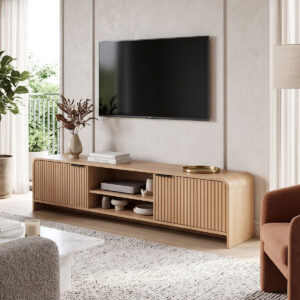


How much storage do I need in a TV stand?
Enough to hide everything you do not want to look at every evening. That usually means one or two closed compartments for devices, drawers for remotes, chargers and board games, and perhaps one open shelf for a speaker or a few books.
My rule: open shelves for things you are proud of, doors for everything else. If you need more storage than a TV stand can give, add a sideboard elsewhere in the room rather than buying an oversized TV unit.
Which material is best for a TV stand?
It depends more on how you live than on the material itself. Each product page lists the materials, so check before you buy.
- Wood and wood veneer: warm, forgiving with small marks, works with most styles.
- Melamine and MDF finishes: practical, easy to wipe, sensible for busy family rooms.
- High-gloss lacquer: sharp and modern, but it shows dust and fingerprints. In a sunny Cyprus living room you will see every speck.
- Glass and metal: light-looking and good in small rooms, but glass needs regular cleaning.
Whatever you choose, keep it out of strong direct sun if you can. Cyprus sun fades finishes, and a TV screen in full sun is a mirror anyway.
Should the TV stand match the coffee table?
Coordinate, do not match. A TV stand and coffee table in exactly the same finish can look like a set lifted straight from a catalogue. I prefer them to share one thing – the wood tone, the metal colour or the leg style – and differ in the rest.
Keep the coffee table in proportion with the sofa, roughly two-thirds of its length, and leave a comfortable walkway between the table and the TV stand. Browse our coffee tables with your chosen TV stand open in another tab and compare finishes side by side. If you are furnishing the whole room, our furniture packages take some of the guesswork out.


What TV stand works in a small living room?
A slim, low stand on legs, or a wall-mounted TV over a shallow unit. Seeing the floor underneath makes a small room look larger, and a shallow depth keeps the walkway clear.
Light colours help, and so does choosing a TV size for the room rather than the biggest screen the budget allows. A huge screen in a narrow apartment living room means sitting too close or too far to the side. For more small-space advice, read our guide to furnishing a small apartment or rental in Cyprus, and browse the whole living room range for pieces that work together.
Mistakes I see all the time
- A stand narrower than the TV. It looks wrong and it is less stable. No style fixes this.
- The TV too high. If you tilt your head back to watch the news, the screen is too high.
- Forgetting the feet. TV feet near the edges need a wider top than the screen width suggests.
- No hole for cables. Then someone drills one. Usually in the wrong place.
- Buying for this TV, not the next one. TVs are replaced more often than furniture. Allow for a size up.
- High gloss in full sun. Beautiful in the photo, a dust display in real life.
Browse our TV stands, and if you are unsure, send me the TV size, the wall width and a photo of the room on WhatsApp at +357 96 592277 and we will tell you what fits. Argos The Classics delivers across the Republic of Cyprus, typically 15 to 20 days after purchase, with free collection available in Larnaca – see delivery and collection for details. Until 28 November 2026 our Black Friday offers apply automatically, with no coupon needed.
Add Argos The Classics as a preferred source on Google →
Frequently asked questions
How wide should a TV stand be?
A TV stand should be at least as wide as the TV and ideally noticeably wider, for example 150 cm or more for a 55 inch TV. Also check that the stand is wider than the distance between the TV's feet.
What is the right height for a TV stand?
For most sofas, a TV stand about 40 to 60 cm high puts the centre of the screen close to seated eye level. The middle of the screen should be at or slightly below your eye height when sitting.
Is a wall unit or a low TV stand better for a small living room?
A low TV stand on legs, or a wall-mounted TV over a shallow unit, usually works better in a small living room. Wall units offer more storage but can dominate a small space.
How do I hide cables behind a TV stand?
Choose a stand with cable outlets or an open back, keep a power strip inside or behind the unit, and bundle the cables with ties or a sleeve. Make sure devices in closed compartments have airflow.
Should my TV stand match my coffee table?
They should coordinate rather than match exactly. Choose pieces that share one element, such as wood tone, metal colour or leg style, and keep the coffee table in proportion with the sofa.
Do you deliver TV stands across Cyprus?
Yes. Argos The Classics delivers across the Republic of Cyprus, typically 15 to 20 days after purchase, with delivery cost calculated at checkout from your address and order size. Assembly can be added at checkout on eligible items.